Price-performance routing: the cheapest model that still solves the task
Routing & Technology

Maximilian Keller
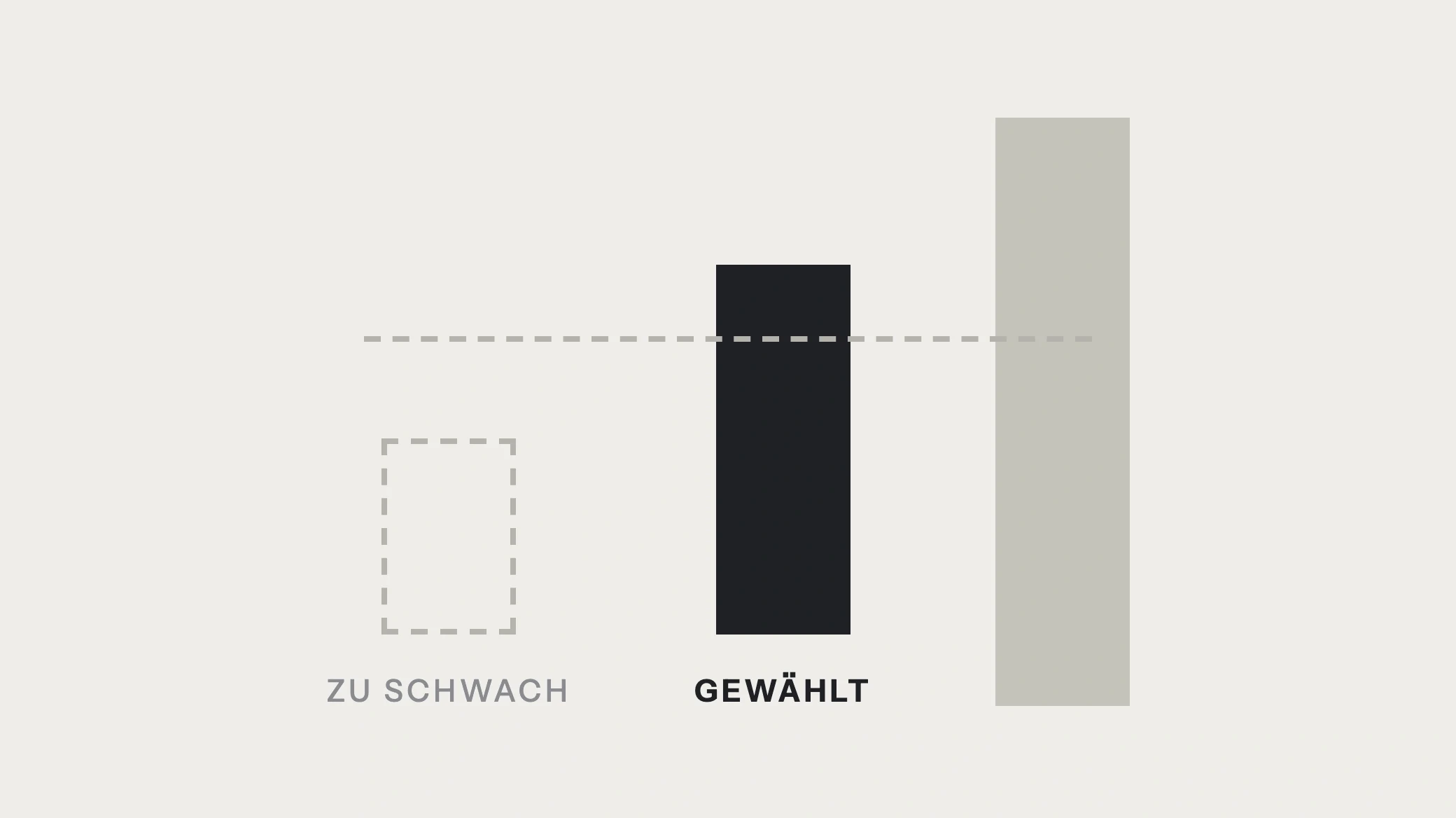
Price-Performance-Routing means: Every request goes to the cheapest model that still solves the specific task in sufficient quality. Done correctly, this can often reduce the AI bill by 60 to 80 percent without sacrificing output quality. This article explains why it pays off, how to divide tasks into price tiers, and how to find the right cost-quality point for each use case.
Key Takeaways
Price-Performance-Routing sends every request to the cheapest model that still solves the task.
Roughly 60 to 80 percent lower model costs are realistic because most requests are simple.
A three-tier model plus a cost-quality score per task type makes the choice measurable.
Prompt caching, batch processing, and multi-provider routing save additional costs.
The reflex of many teams is to use the strongest available model for everything. Better safe than sorry. The problem: The price span between frontier and budget models now reaches up to around 150-fold for input tokens. The difference in quality for simple tasks, on the other hand, is often in the single-digit percentage range. So you pay 150 times the price for a few percentage points that nobody notices in a classification. How resilient these savings really are and where their limits lie is explained in the technical overview of model routing.
Why the price gap is getting wider
OpenAI, Anthropic, and Google now offer tiered model lineups, from tiny Nano models to large reasoning models. Between the smallest and largest tier of a single provider, the price can easily differ by a factor of 20. Across providers, the span becomes even larger.
The quality curve is flatter than the price curve. For simple, well-defined tasks like categorizing, extracting, or reformatting, a small model achieves a very large portion of the quality of a frontier model, at a fraction of the cost. Routing studies like RouteLLM and FrugalGPT show exactly this pattern. The surcharge only pays off where true multi-step reasoning is required.
Price Snapshot
A rough guide by price tier (figures per 1 million tokens, introductory prices may change):
Tier | Input | Output | Ideal for |
|---|---|---|---|
Nano Class | $0.10 to $0.40 | $0.40 to $1.60 | Classification, extraction, simple translation |
Mid-range | $0.40 to $2.00 | $1.60 to $10.00 | Summaries, Q&A, short texts, simple code |
Frontier | $2.00 to $3.00 | $10.00 to $15.00 | Multi-step analysis, agents, complex code generation |
The Routing Framework by Task Complexity
The most practical start is a three-tier model that maps each task to a tier.
Tier 1: Nano Class
For simple pattern matching: categorization into predefined classes, extraction from forms, text reformatting, simple translations. The smallest model almost always wins here.
Tier 2: Mid-range
For moderate reasoning: summaries of articles and documents (up to about 10,000 tokens), Q&A from knowledge bases, short texts, simple code generation.
Tier 3: Frontier
For deep reasoning: multi-step analyses, agentic software engineering, legal or medical document analysis, research synthesis. The surcharge is justified here.
Building a Cost-Quality Score
Routing blindly is useless; you need numbers. In three steps:
Define a quality metric that fits the task (e.g., accuracy rate in classification, match rate with reference in extraction).
Test 50 to 100 real cases through each tier and log quality and token costs.
Calculate the cost per quality point: total cost divided by the quality score.
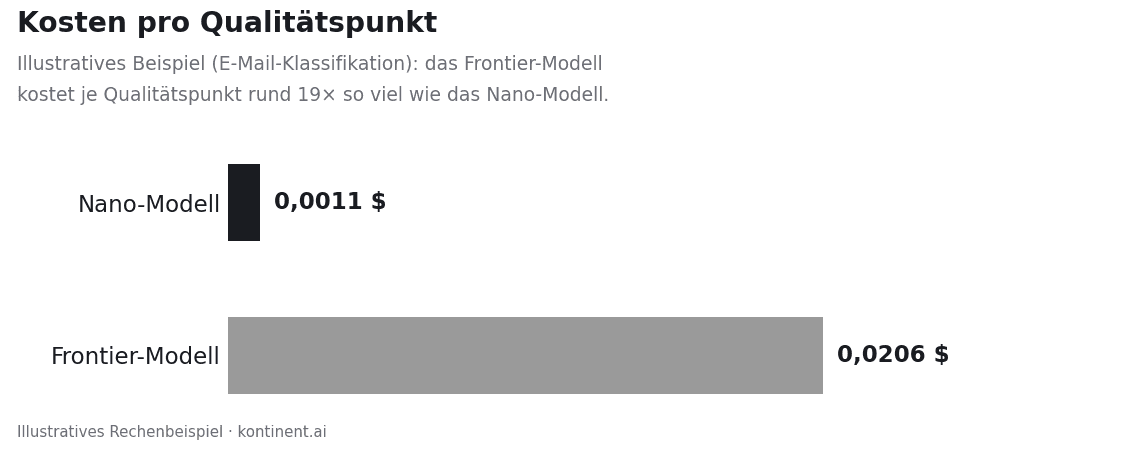
A calculation example to illustrate, based on email classification: A Nano model achieves a 94% accuracy rate at $0.10 per 1 million tokens, or around $0.0011 per quality point. A Frontier model achieves 97% at $2.00 per 1 million tokens, around $0.0206 per point. In this example, the Nano model is about 19 times more cost-effective, with three percentage points less quality. Whether the surcharge for the stronger model is worth it is something you decide per task based on your own measurement, not flat rate.
Smart Routing with kontinent.ai
To keep routing practical, you shouldn't have to rewrite half the code for a model change. Via a unified API like kontinent.ai, you only change the model name in the request. Endpoint, authentication, and response format remain the same. This way, you target the right tier per task type without maintaining a separate integration for each provider. Because everything runs on an infrastructure hosted in the EU, the data residency issue is resolved. How a router is technically built is explained in the technical overview.
Three Levers That Save Even More
Fallback Routing. If the primary model is overloaded or unavailable, the next one in the list automatically steps in. The application remains operational without any code changes.
Prompt Caching. Recurring context like system prompts or knowledge bases can be cached. Depending on the provider, there are discounts of up to 90% on cached tokens, as described by Anthropic's prompt caching, for example. For 10,000 requests a day with a 2,000-token system prompt, this quickly adds up to several hundred euros a month.
Batch Processing. What doesn't have to happen in real-time runs asynchronously in batches, often at half the price. Combined with Tier 1 models, you get the most out of it this way.
Multi-Provider Routing as Cost Insurance
Being dependent on a single provider leaves you at the mercy of their prices and outages. Multi-provider routing via a unified API allows instant switching in case of price increases or outages, without code changes. This gives you both negotiating leverage and resilience, while reducing vendor lock-in risk.
Frequently Asked Questions
What is Price-Performance-Routing?
A routing strategy that sends each request to the cheapest model that still solves the task with sufficient quality, instead of always using the strongest one by default.
How much can be saved with it?
In practice, roughly 60 to 80 percent of model costs, because the majority of real-world requests consist of simple tasks that do not require a frontier model. The resilient study numbers and their limits are contextualized in the technical overview.
Does quality suffer with cheaper models?
Hardly at all for simple, well-defined tasks. Small models often reach 94 to 97 percent of frontier quality there. Measure this per task type instead of guessing.
How do I measure the right compromise?
Via the cost per quality point: collect quality and token costs per tier on 50 to 100 real cases and divide the total cost by the quality score.
Do I have to write custom code for each provider?
No. Via a unified API like kontinent.ai, you change the model via parameters; endpoint and response format remain the same.
As of: August 2026 · kontinent.ai. Prices are indicative and subject to change.