Enterprise Multi-Model API: One interface for all AI models
Basics

Maximilian Keller
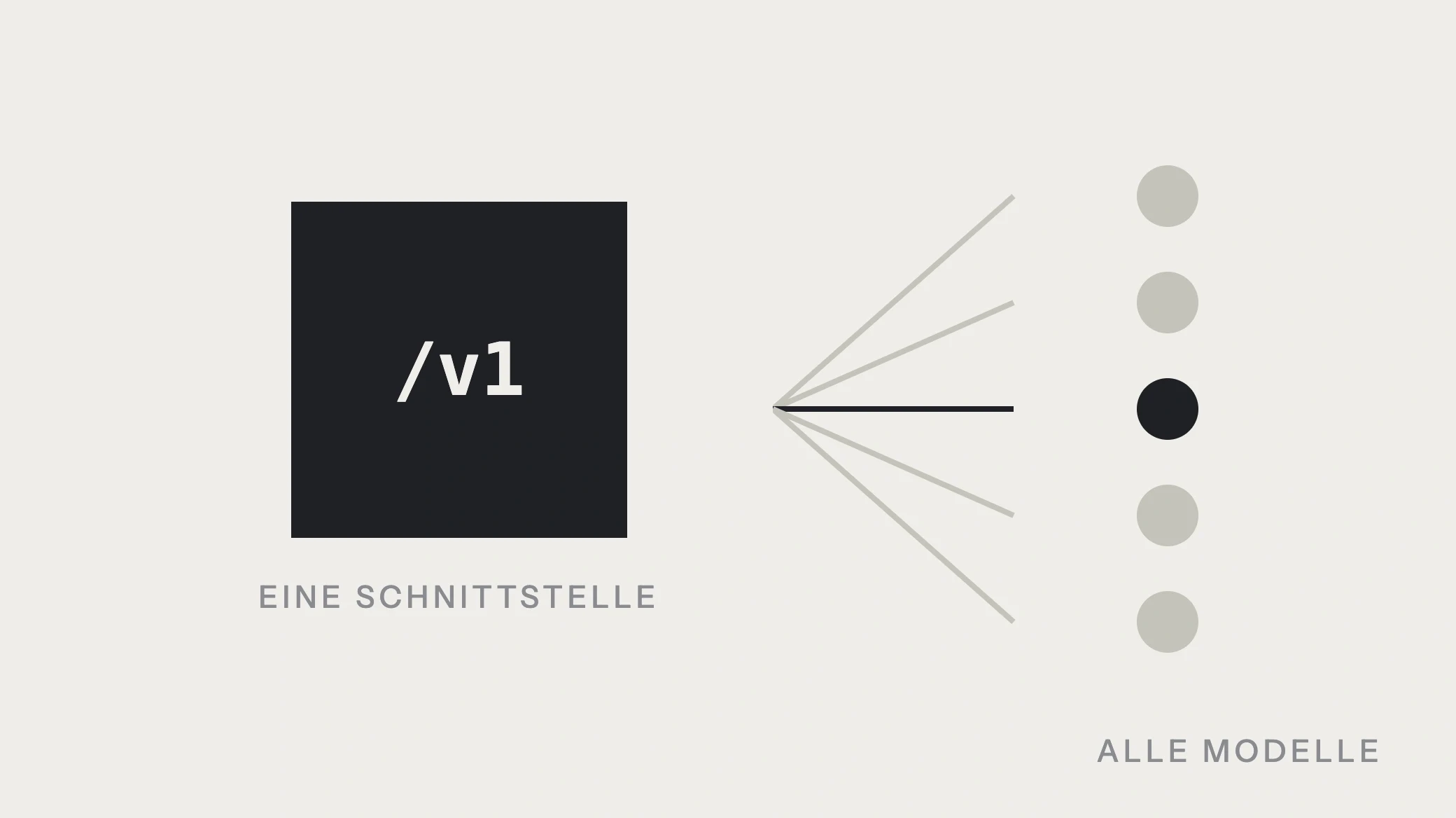
A multi-model API is a single interface through which companies can access various AI models from different providers without having to adapt their own application separately for each model. It allows the most suitable model to be selected automatically depending on the task, costs to be controlled, and providers to be switched in the background without rewriting the application code.
Table of Contents
Why is a single model no longer enough?
What does a multi-model API mean in concrete terms?
Access vs. control: the crucial difference
Multi-model API: Comparison of criteria
What companies should look out for when choosing
FAQ
Conclusion
Summary of Key Points
A multi-model API is an interface for many models – this article explains structure, criteria, and selection.
Why switching makes economic sense and what lock-in costs, we cover separately in the business case.
The crucial factor is not access to many models, but control over data flow, costs, and interchangeability.
The market is moving fast: Menlo Ventures measures a doubling of enterprise LLM spending within six months.
Why is a single model no longer enough?
This article answers the How question: How is a multi-model API structured and how do you recognize a good one? The Why question – i.e., what a provider change costs and when it pays off – is answered by our business case against vendor lock-in.
No single AI model is equally good at all tasks: One model may excel at summarizing text, another at mathematical reasoning, a third at handling very long documents. Companies that commit to a single model automatically forfeit the strengths of the others.
This realization has now also gained ground in practice. According to the Databricks State of AI Agents Report 2026, 78% of companies already use two or more LLM families simultaneously, and the share of companies with three or more model families rose from 36% to 59% between July and October 2025. An a16z survey of 100 Enterprise CIOs (2025) shows a similar trend: 37% of respondents use five or more models in production, up from 29% the previous year. Added to this is the speed of the market: New, more powerful, or cheaper model versions appear at short intervals, and anyone who is technically tied to only one provider cannot take advantage of these advancements without additional effort.
What does a multi-model API mean in concrete terms?
At its core, the term describes a single interface through which different models from different providers can be accessed without having to adapt the own application separately for each model. A development team defines what a request looks like once, and can then switch the model in the background without touching the application code.
In practice, this means, for example:
A support chatbot uses a fast, inexpensive model for simple queries and automatically switches to a more powerful model for more complex cases.
An internal analysis tool initially tests a new model on only a portion of queries before switching over completely.
A company with offices in several countries can choose different models or regions for processing depending on data privacy requirements.
Access vs. control: the crucial difference
Many solutions on the market offer pure access to as many models as possible. This is a good start, but is rarely sufficient for companies in production. The decisive factor is what happens between the query and the response: Is it logged which model saw which data? Are there budget limits per team? Can it be traced why a certain response was generated? These questions separate simple model access from a true enterprise solution.
The fact that access alone is not enough is also shown by the market movement: According to the Menlo Ventures report on the LLM market (mid-2025), companies rarely switch providers completely - only 11% did so during the survey period -, but regularly update to newer models within their existing stack (66%). A multi-model API makes exactly this process predictable, instead of leaving it to chance.
Multi-model API: Comparison of criteria
Criterion | Simple model access | True multi-model API |
|---|---|---|
Model selection | Few well-known models | Broad, task-specific selection |
Switching | Requires code change | Configuration change |
Cost control | Distributed, hard to track | Centralized, per team/project |
Logging | Usually non-existent | Centralized logging |
Data processing | Often not controllable | Selectable by region/compliance |
According to Menlo Ventures, “2025 Mid-Year LLM Market Update" enterprise spending share for LLMs rose from 3.5 to 8.4 billion USD within six months; at the same time, market shares shifted significantly between providers. Anyone who commits to a single provider is betting on a snapshot in time. Basics on the aggregation layer itself can be found in What is an LLM gateway?.
What companies should look out for when choosing
Breadth of model selection: Does the API cover the models that are relevant to your use cases, and not just a handful of familiar names?
Switching without code changes: Can a model be replaced by adjusting a configuration, or does the application code have to be rewritten for this?
Transparent costs: Can you see at a glance which team is consuming how much budget for which model?
Data processing: Where are the requests processed, and can this be reconciled with your own compliance requirements?
FAQ
What is the difference between a multi-model API and an LLM gateway? The terms are often used synonymously. A multi-model API emphasizes the uniform interface for multiple models, an LLM gateway additionally emphasizes routing, logging, and failover as core functions.
Is a multi-model API worth it even with only two models? Yes. Even with just two models used in production, integration effort arises, which can be significantly reduced by a uniform interface, regardless of the eventual number of models.
How often do companies actually switch AI providers? According to Menlo Ventures (mid-2025), only 11% of the surveyed companies completely switched providers in the past year, while 66% merely upgraded to newer models with their existing provider.
Does a multi-model API automatically increase costs? No, on the contrary: Through targeted routing, simple queries can be forwarded to cheaper models and only complex cases to more expensive models, which often reduces overall costs rather than increasing them.
Does a multi-model API replace the decision for a specific model? No. It makes switching and comparing different models easier, but the content evaluation of which model is best suited for a task remains the company's responsibility.
Conclusion
A multi-model API is not a luxury for large corporations, but has become a practical necessity for any business that seriously deploys AI. It ensures that the choice of model remains a tactical decision and not a strategic commitment for years to come.
Kontinent bundles exactly this flexibility in one interface, developed with a view to European requirements for data protection and cost control. Anyone who wants to check which models are suitable for their own use cases can discuss this with our team without obligation.
Sources
a16z, “How 100 Enterprise CIOs Are Building and Buying Gen AI" (2025)
Databricks, “State of AI Agents" (2026) – Telemetry from over 20,000 organizations
Regulation (EU) 2016/679 (GDPR) – Art. 28
As of: August 27, 2026 · kontinent.ai.