What is an LLM Gateway? Definition, Benefits, and Business Use in 2026
Basics

Maximilian Keller
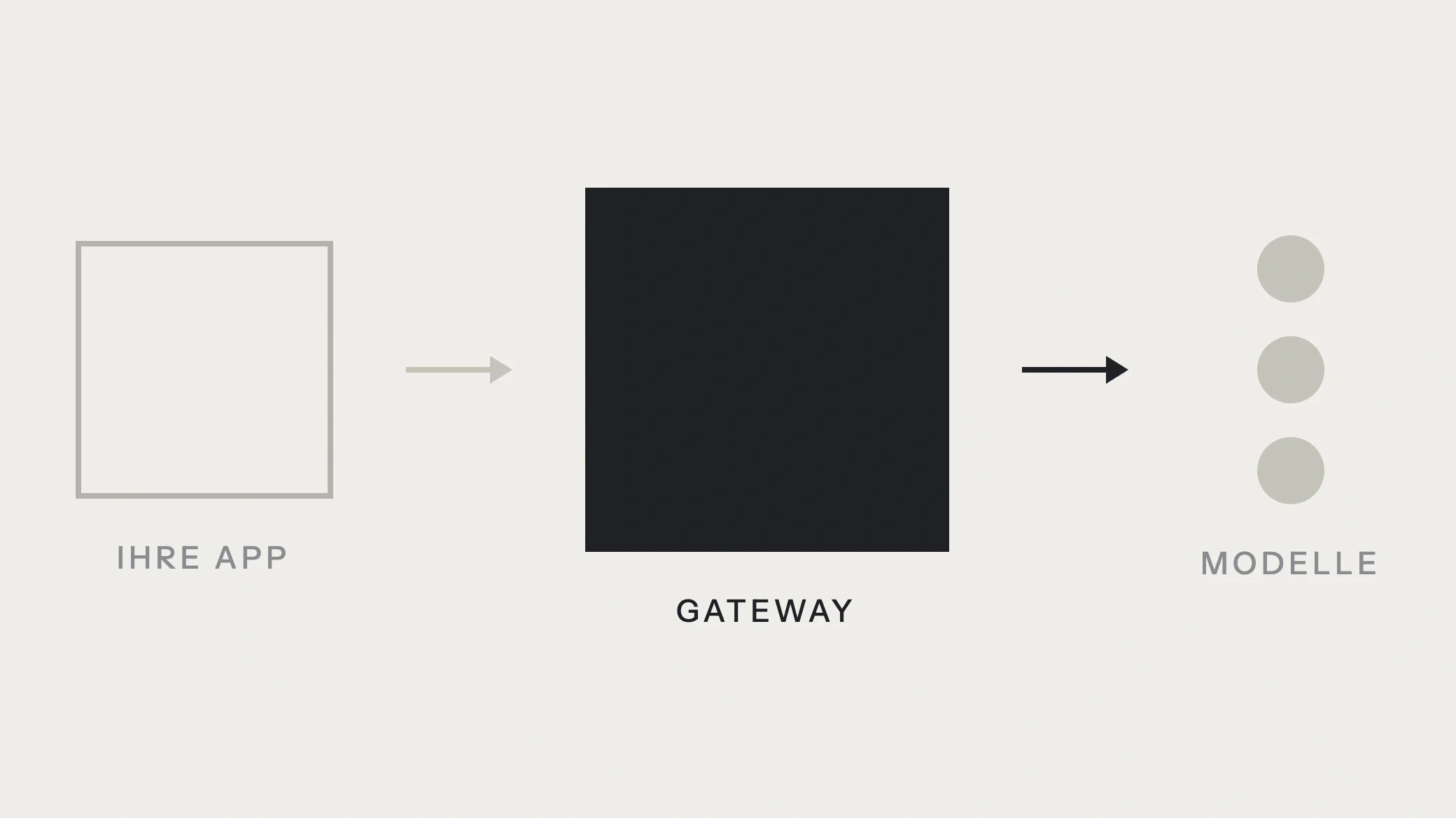
An LLM gateway is a central interface that bundles access to multiple AI language models from different providers and makes them uniformly available. Applications only communicate with the gateway, which forwards requests, logs costs and usage, and automatically switches to another model in the event of outages. This keeps the choice of model flexible without needing to adapt existing code.
Table of Contents
How does an LLM gateway work?
Why is this topic becoming so relevant for companies in 2026?
What does a good gateway actually achieve?
LLM Gateway vs. Direct Integration in comparison
A common misunderstanding
FAQ
Conclusion
Key takeaways in brief
An LLM gateway bundles access to many language models behind a single, mostly OpenAI-compatible interface.
The benefit lies less in access and more in control: costs, failover, logging, data residency, and model origin in one place.
According to a16z, around 37% of companies use five or more models productively – a gateway makes this manageable.
A gateway does not replace a legal basis, but it bundles DPAs, subprocessors, and evidence in one place.
How does an LLM gateway work?
An LLM gateway sits as an intermediate layer between your own application and the various AI providers. Instead of building a dedicated integration for each model, the application only talks to the gateway, which forwards the request to the appropriate model, returns the result, and handles billing, logging, and failover in the background.
You can think of it like a telephone switchboard: In the past, you had to call each department individually and know the extension; today, you dial one number and get connected. An LLM gateway takes over this intermediary role for AI models.
Why is this topic becoming so relevant for companies in 2026?
Three developments are currently driving the relevance of LLM gateways: the proliferation of multiple models per company, the pace of new model releases, and growing regulatory requirements.
The use of multiple models is now the standard rather than the exception. According to the Databricks State of AI Agents Report 2026, 78% of companies use two or more LLM families simultaneously, and the share of companies with three or more model families rose from 36% to 59% between July and October 2025. A survey by a16z among 100 enterprise CIOs (2025) paints a similar picture: 37% of respondents now use five or more models in production, up from 29% the previous year - in part to avoid lock-in to a single vendor.
At the same time, the model landscape is changing rapidly: New, more powerful, or cheaper models appear at short intervals, and anyone who is tightly locked into one provider can only benefit from this development with additional development effort.
Thirdly, regulatory requirements are visibly tightening: The transparency obligations of the EU AI Act (Regulation (EU) 2024/1689) under Art. 50 have been in force since August 2, 2026. The high-risk obligations under Annex III – automated logging, documented risk management systems, and conformity assessments – were postponed to December 2, 2027, by the Digital Omnibus, but will then apply unchanged. Violations can be punished with fines of up to 35 million euros or 7% of global annual turnover. Without a central layer that logs which model processed which data and when, proving compliance with these requirements quickly becomes confusing.
What does a good gateway actually achieve?
Unified interface: Instead of maintaining a separate integration for each provider, the application uses a single, consistent format. Integrating a new model becomes a configuration change instead of a development project.
Routing and Fallback: Requests can be distributed to different models based on cost, speed, or availability. If a provider fails, another automatically takes over without the application noticing.
Cost transparency: All requests converge in one place, allowing budgets to be set per team or project and spending to be tracked.
Governance and logging: Who requested which model with what data and when? This question can be answered centrally instead of searching for it in multiple systems - a prerequisite for EU AI Act compliance evidence.
The a16z, "How 100 Enterprise CIOs Are Building and Buying Gen AI" (2025) survey shows how many models companies actually run in parallel: Around 37% use five or more models productively, deliberately mixing providers according to costs, capabilities, and risks. It is precisely this diversity that makes a bundling layer necessary. What this means for architecture is explored in depth in our article on the Multi-Model API for Enterprises.
LLM Gateway vs. Direct Integration in comparison
Criterion | Direct integration per provider | LLM Gateway |
|---|---|---|
Integration effort | Separate connection for each model | One interface for all models |
Model switch | Code change necessary | Configuration change |
Fail-safety | No automatic fallback | Automatic switching to alternative model |
Cost overview | Distributed across individual provider dashboards | Centralized in one place |
Logging for EU AI Act / GDPR | Must be built individually for each provider | Centralized and uniform |
In modern gateways, a router decides which model is the right one for which request. The technical approaches behind this are described in our overview of the state of routing research, while the economic side is covered in the guide to price-performance routing.
A common misunderstanding
Many people initially think of an LLM gateway purely as a developer tool. In fact, it affects the business side just as much: If the IT department has no central overview of AI spending, controlling often only notices this when the bill from an individual provider suddenly turns out to be significantly higher than planned. A gateway makes such surprises visible before they become a problem.
FAQ
What is the difference between an LLM gateway and a normal API? A normal API connects an application to exactly one provider. An LLM gateway lies one level above and connects an application to multiple providers simultaneously, via a single, unified interface.
Do smaller companies also need an LLM gateway? As soon as more than one AI use case is running productively, such as customer support and document analysis, a gateway is worthwhile even for smaller teams, as it simplifies integration effort and cost overview from the very beginning.
How does an LLM gateway support EU AI Act compliance? It centrally logs which model processed which request with what data and when. This makes it easier to prove compliance with the transparency obligations under Art. 50, which have applied since August 2, 2026, and the documentation and logging obligations for high-risk systems, which take effect from December 2, 2027.
Does a gateway automatically increase resilience? Yes, provided fallback rules are configured: If a model or provider fails, the gateway can automatically forward requests to an alternative model without the application needing to be adjusted.
Does an LLM gateway replace the decision of which model to use? No. The gateway manages access and routing, while the substantive selection of the right model for a task remains a strategic decision for the company.
Conclusion
At its core, an LLM gateway is a simple idea: one interface instead of many, one overview instead of a patchwork quilt. For companies that are no longer just experimenting with AI, but are building on it productively, this layer is shifting from a nice-to-have to a basic prerequisite in 2026.
Kontinent offers exactly this layer, developed in Europe and with a focus on data residency and cost control. Anyone wishing to know how this can be implemented in their own setup can reach out to our team for a non-binding exchange.
Sources
a16z, „How 100 Enterprise CIOs Are Building and Buying Gen AI" (2025)
Regulation (EU) 2024/1689 (AI Act)
Regulation (EU) 2026/1744 (Digital Omnibus on AI), in force since 27.07.2026
Databricks, „State of AI Agents" (2026) – Telemetry from over 20,000 organizations
As of: August 27, 2026 · kontinent.ai.