Avoiding vendor lock-in with AI models: The business case for multi-model APIs
Basics

Maximilian Keller
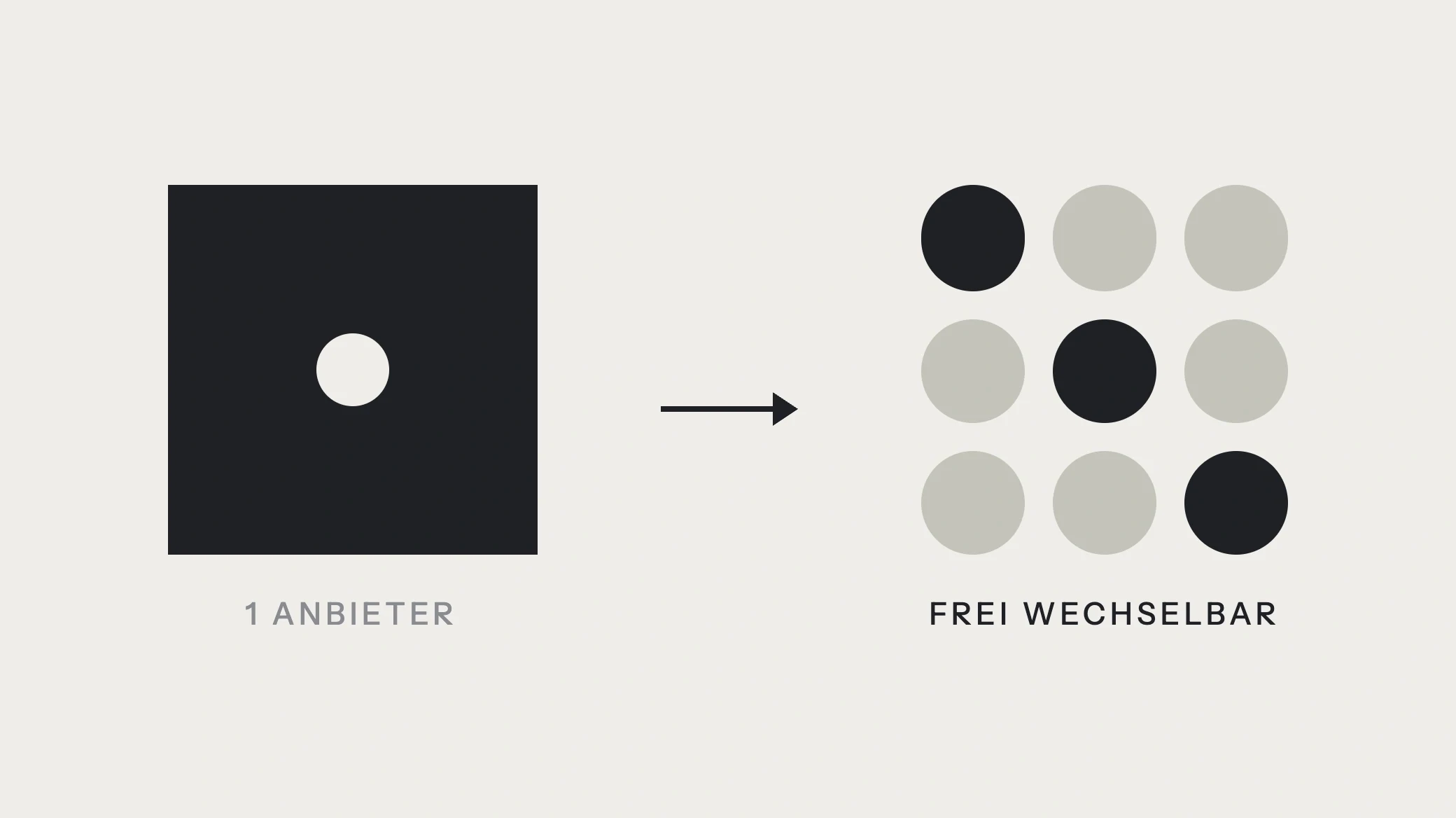
Vendor lock-in with AI models means that an application is so tightly bound to a single AI provider that switching becomes technically complex and economically risky. Today, this affects significantly more companies than it did two years ago because AI applications are increasingly running in real business processes rather than pilot projects.
Table of Contents
Why the risk is increasing right now
How to recognize vendor lock-in
What vendor lock-in actually costs
The business case for a multi-model architecture
How to avoid lock-in in practice
FAQ
Conclusion
Key Takeaways
Vendor lock-in with AI is rarely a contractual issue, but rather an architectural one: how deeply embedded is a provider in the code?
The costs do not arise when switching, but rather from not being able to switch: poorer pricing, lack of failover, blocked compliance requirements.
According to a16z, around 37% of companies are already running five or more models – single-vendor is no longer the norm.
This article provides the economic business case; the technical implementation is covered in the article on the multi-model API.
Why the risk is increasing right now
In recent years, AI has moved from the testing phase into production. Customer support, document processing, and internal tools now depend on real business processes. As long as AI was just an experiment, losing access to a model was a nuisance. Today, it can bring a process to a complete standstill: a widely cited example is the ChatGPT outage in January 2025, which affected GPT-4, 4o, and Mini models, impacting companies that had relied solely on a single provider without a fallback option.
At the same time, the market for language models is developing very rapidly. New, more powerful, or cheaper models appear at short intervals. Anyone who is tightly bound to one provider misses out on this development because switching would mean rewriting large parts of their own application.
Thirdly, regulation is playing an increasing role: the transparency obligations of the EU AI Act under Art. 50 have been in effect since August 2, 2026; the high-risk obligations under Annex III were postponed to December 2, 2027, by the Digital Omnibus. Both require documented data processing and origin. If an application is inextricably interwoven with a single, often non-European provider, it becomes more difficult to meet these requirements cleanly and verifiably.
How to recognize vendor lock-in
A few signs indicate an existing lock-in risk:
All productive AI applications run exclusively through a single provider.
Switching would mean redevelopment of major parts of the application instead of just changing a configuration.
There is no documented plan for what happens if this provider increases prices, changes terms of use, or temporarily fails.
No one in the company really has an overview of which model is used in which process.
If two or more of these points apply, it is worth taking a closer look at your own architecture. Awareness of this risk is already high in practice: in a recent market analysis (Trantor, 2026), 81% of surveyed business leaders stated they were concerned about dependency on individual AI providers, while at the same time only 6% believe they can switch their primary AI provider without significant operational disruption.
What vendor lock-in actually costs
The costs of a forced provider switch are rarely visible from the start, but become very clear once the switch is necessary. According to an analysis by Kellton (2025), platform migrations cost 57% of the surveyed IT decision-makers who already had to perform such a migration more than one million US dollars. The SaaS and AI cost management company Zylo puts the average hidden additional AI costs per organization at $384,500 per year and observed a 108% increase in AI costs for 2025, with 78% of surveyed IT leaders experiencing unexpected additional costs in the AI sector.
Market trends support this: Menlo Ventures, "2025 Mid-Year LLM Market Update" documents how the market shares of leading providers shifted significantly within half a year, while a16z, "How 100 Enterprise CIOs Are Building and Buying Gen AI" (2025) shows that around 37% of companies use five or more models in production and deliberately mix providers based on cost, capability, and risk. Anyone who hardwires today loses precisely this agility. What an interchangeable architecture actually looks like is described in the article on the Multi-Model API.
The Business Case for a Multi-Model Architecture
Moving away from a single, fixed provider lock-in is initially a technical issue, but it has very concrete business implications:
Bargaining Power: Those who are technically capable of switching providers negotiate from a much stronger position when it comes to prices or terms.
Cost Control: Tasks can be assigned to the most cost-effective suitable model, instead of running everything through a single, potentially more expensive model.
Resilience: If a provider fails or is restricted at short notice, an application can automatically fall back on another model instead of coming to a complete standstill.
Regulatory Flexibility: If requirements for data processing change or new regulation comes into force, it is possible to react faster if the application is not bound to a single provider.
A second, often overlooked lock-in factor is the legal situation: anyone bound to a provider without EU data residency cannot react to new compliance requirements without touching the architecture. What paths exist is shown in Using OpenAI, Claude, and Gemini in Europe.
How to avoid lock-in in practice
The most important step is an abstraction layer between your own application and the individual model providers, usually in the form of a central API or a gateway. The application then only talks to this layer, while in the background it is decided which model actually processes the request.
It is important to anchor as few provider-specific functions as possible directly in the application. Where special features of a single provider are indispensable, they should be clearly isolated so that the core of the application remains independent.
Equally important is the organizational side: contracts with AI providers should contain clear rules on data portability from the start, and there should be a regular assessment of how high the switching costs actually would be at present.
Comparison: Vendor Lock-in vs. Multi-Model Architecture
Risk | Single-Provider Dependency | Multi-Model Architecture |
|---|---|---|
Provider price increase | Affects 100% of traffic unprotected | Traffic can be shifted |
Provider outage | Complete standstill possible | Automatic fallback |
Regulatory change | Expensive retrofitting required | Faster adaptation |
Bargaining power | Weak, as there is no alternative | Strong, as the switching option is real |
FAQ
What is the difference between vendor lock-in and a conscious provider decision? A conscious decision for a provider is not a problem as long as a realistic path to switch exists. Lock-in only occurs when switching has become practically impossible technically or economically.
What are the typical costs of a forced provider switch? According to Kellton (2025), platform migrations cost more than one million US dollars for 57% of affected IT decision-makers, depending on the scope and degree of provider dependency.
Is a multi-model API alone enough to avoid lock-in? It is the technical foundation, but it must be supplemented by organizational measures, such as clear contract clauses on data portability and a regular assessment of actual switching costs.
Does vendor lock-in only affect large companies? No. Smaller teams are often more heavily affected because they rarely have dedicated resources to handle a migration at short notice if a provider increases prices or fails.
What role does the EU AI Act play regarding lock-in? The transparency obligations under Art. 50, in force since August 2, 2026, and the high-risk obligations taking effect from December 2, 2027, require documented data processing. An application that is inextricably bound to a single, often non-European provider will have a harder time providing this evidence than a provider-independent architecture.
Conclusion
Vendor lock-in with AI models is not just a technical detail, but a strategic risk that becomes more important with increasing dependence on AI in business processes. The effort to rely on a provider-independent architecture from the beginning is significantly lower than the costs of a forced switch under time pressure.
Kontinent was developed specifically for this problem: an interface that leaves companies the choice of model without binding them to a single provider. Anyone who wants to assess their own lock-in situation can exchange ideas with our team without obligation.
Sources
a16z, "How 100 Enterprise CIOs Are Building and Buying Gen AI" (2025)
Regulation (EU) 2024/1689 (AI Act)
Kong Learning Center, "Vendor Lock-In in the Age of AI" (ChatGPT outage from January 23, 2025)
Kellton – 57% of IT leaders spent over $1M on platform migrations · Trantor · Zylo, "2026 SaaS Management Index"
As of: August 27, 2026 · kontinent.ai.