Using Claude in the EU: Comparing Anthropic API, Bedrock Frankfurt, Vertex AI, and Microsoft Foundry
Compare

Dominik Keller
Founder, Kontinent
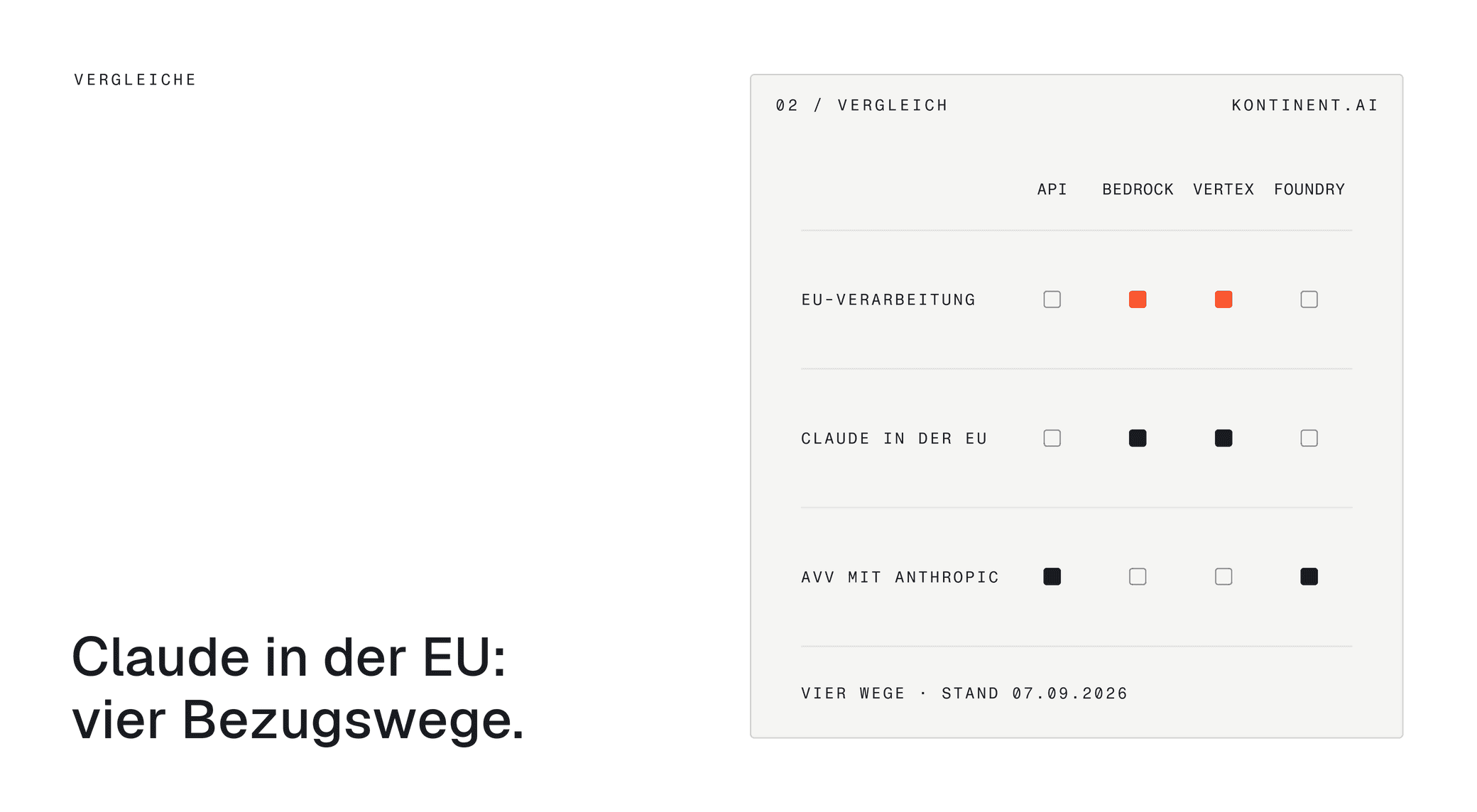
Claude can be used in the EU in two ways with guaranteed EU processing: via Amazon Bedrock with EU inference profiles and via Google Vertex AI with the EU multi-region endpoint. The Anthropic API only recognizes "global" and "us"; Microsoft Foundry does not yet have an EU data zone for Claude. Which path is right for you depends on the model, retention rules, and contract chain.
The question "Are we allowed to use Claude?" is usually answered in data protection approvals with a look at the provider. That falls short. The same model behaves differently on the four procurement channels: it runs in different data centers, under different contracts, with different retention periods, and at different prices. A team using Claude Sonnet 5 via Bedrock in Frankfurt has a different legal situation than one sending the same request to api.anthropic.com.
This article compares the four paths side by side: the Anthropic API (first party), Amazon Bedrock, Google Vertex AI, and Microsoft Foundry. For each path, we answer the same five questions: who is the contracting party, where does inference run, which Claude models are available in the EU, what is stored, and what does the EU version cost compared to the list price. The information comes from the linked provider documents and from two of our own tests on September 7, 2026: querying the Bedrock inference profiles in Frankfurt and test calls against the EU endpoints of Vertex AI.
Summary
Anthropic API: The contracting party for EEA customers is Anthropic Ireland Limited, but inference only runs "global" or "us". There is no EU option, and data is located in the US.
Amazon Bedrock: Nine current Claude models run via EU inference profiles in six EU regions, with zero storage as standard. Fable 5 and Fable 5.1 are only available with worldwide routing and 30-day storage by AWS.
Google Vertex AI: Opus 5, Sonnet 5, and Fable 5.1 are listed for Europe as multi-region; Fable 5.1 requires agreement to a 30-day retention. Regional endpoints cost a 10 percent premium.
Microsoft Foundry: Anthropic remains the seller and processor, with Microsoft only providing the portal and billing. Deployments are available as "Global Standard" or "US Data Zone"; an EU data zone is announced as "Coming 2026".
Anthropic's Covered Models rule (30 days retention for Mythos 5, Mythos 5.1, Fable 5, and Fable 5.1) applies to all four paths. Anyone wishing to bypass it must switch to Opus 5 or Sonnet 5 or wait for the Enterprise Frontier Safeguards.
Table of Contents
Why the procurement channel determines the legal situation
Path 1: The Anthropic API
Path 2: Amazon Bedrock in Frankfurt and five other EU regions
Path 3: Google Vertex AI with the EU multi-region endpoint
Path 4: Microsoft Foundry
Comparison table: four paths, five criteria
The Covered Models rule applies everywhere
What does the EU path cost?
Decision guide: which path for which case
How kontinent.ai integrates Claude
Frequently Asked Questions
Why the procurement channel determines the legal situation
The procurement channel determines who your data processor is, in which data center the inference runs, and which retention rules apply. The model is the same on all paths, but the legal situation is not. Three things differ for each path:
The contracting partner. With Bedrock, you conclude the data processing agreement (DPA) with Amazon Web Services EMEA SARL; with Vertex, it is Google Ireland Limited; with the Anthropic API, it is Anthropic Ireland Limited. With Microsoft Foundry, unlike Azure OpenAI, it is also Anthropic and not Microsoft.
The location of processing. The hyperscalers offer EU regions, while the Anthropic API does not. This is the core question for Art. 44 et seq. GDPR: Is a third-country transfer taking place, and if so, on what basis?
The retention rule. Whether and for how long prompts are stored after the response depends on the path and the model. We described what Zero Data Retention means for the major providers and where the exceptions lie in detail in our post Zero Data Retention with OpenAI, Anthropic, and Google.
Path 1: The Anthropic API
The Anthropic API does not offer EU processing. According to the documentation, the inference_geo parameter knows exactly two values: "global" (default, inference "in any available geography") and "us" (US infrastructure only). The storage location for data at rest, the "Workspace geo", can currently only be set to "us". Under "Current limitations" it is explicitly stated: only "us" and "global" are available.
Contractually, however, the path is set up within Europe. The Commercial Terms define the contracting partner as "Anthropic Ireland, Limited if Customer resides in the European Economic Area, Switzerland or UK", governed by Irish law with dispute resolution in Dublin. The Data Processing Addendum is incorporated into the Terms by reference and contains the EU Standard Contractual Clauses (Modules 2 and 3). Training on customer content is excluded. For the assessment, this means: you have an EU contracting partner with SCCs, but processing takes place in the US or globally. A Transfer Impact Assessment is therefore mandatory, not optional.
Two details that are often missing in discussions: First, the US restriction costs money. For Claude 4.6 and newer models, Anthropic charges 1.1 times the list price for inference_geo: "us" across all token categories. Second, the same applies to "Claude Platform on AWS", which Anthropic runs itself via the AWS Marketplace. The documentation states: data "might not reside in AWS", and inference "might route to Anthropic's primary cloud". This is not a Bedrock replacement, but rather the Anthropic API with AWS billing.
On its regional availability page, Anthropic only lists AWS Bedrock and Google Vertex AI as available paths for Europe; Microsoft Foundry is listed there as "Coming 2026". Its own API does not appear in this table.
Path 2: Amazon Bedrock in Frankfurt and five other EU regions
Amazon Bedrock is currently the path with the largest selection of Claude models in the EU. We queried the inference profiles in the eu-central-1 region using the AWS CLI on September 7, 2026. Result: Nine current Claude models have an EU profile with the prefix eu.: Haiku 4.5, Sonnet 4.5, Sonnet 4.6, Sonnet 5, Opus 4.5, Opus 4.6, Opus 4.7, Opus 4.8, and Opus 5. Each of these profiles is allowed to process requests in exactly six target regions: Frankfurt (eu-central-1), Ireland (eu-west-1), Paris (eu-west-3), Stockholm (eu-north-1), Milan (eu-south-1), and Spain (eu-south-2). AWS documents that the target region list of a geographically bound profile never changes. A request to eu.anthropic.claude-sonnet-5 from Frankfurt therefore remains within the EU, but may be answered in Stockholm.
The exception is the latest models. Fable 5 and Fable 5.1 are listed as foundation models in Frankfurt and Dublin, but have exclusively a global. profile. According to AWS, a global profile can route to all commercial regions, including North America and Asia. Anyone using Fable on Bedrock therefore has no EU guarantee, regardless of which region the call is made from.
Retention. According to its own documentation, Bedrock operates with "zero operator access" and does not store inputs and outputs by default. An exception applies to Fable 5 and Fable 5.1: "all traffic will be retained for up to 30 days for automated offline abuse detection", and flagged content can be reviewed by AWS personnel. According to AWS, the data remains within the AWS boundary and is not shared with Anthropic. To be able to call Fable at all, you must set the data retention mode of your account or project to aws_review; under none or default, Bedrock reports the model as "unavailable". Customers eligible for the Enterprise Frontier Safeguards receive ZDR until December 31, 2026. If you use cross-region inference, you should know: retained data is stored in the target region where the request was processed.
Contract. The contracting partner is Amazon Web Services EMEA SARL in Luxembourg; the DPA is the AWS GDPR Data Processing Addendum. The AWS Service Terms exhaustively list the services whose content AWS may use for training; Bedrock is not on this list. The training exclusion is therefore contractual, not just a product claim.
Path 3: Google Vertex AI with the EU multi-region endpoint
On Google Cloud, which now calls the platform "Gemini Enterprise Agent Platform", the current Claude models for Europe are hosted on a multi-region endpoint. Google's model pages list "Europe: Multi-region" for Opus 5, Sonnet 5, and Fable 5.1 under "Model availability" and "ML processing"; individual EU regions like europe-west1 are only available for older models, such as Haiku 4.5. Anthropic's documentation confirms this: regional endpoints support Sonnet 4.6 and earlier, while newer models run via the global or multi-region endpoints. The EU endpoint is named aiplatform.eu.rep.googleapis.com and dynamically distributes requests to regions within the EU.
We verified this from our own Google Cloud project on September 7, 2026, using test calls of one token. Opus 5 responded via the EU multi-region endpoint with HTTP 200. The same request to the individual regions europe-west1 and europe-west4 hit a quota of zero (HTTP 429): the model is offered there, but Google allocates fixed quotas for individual regions that must be requested. Fable 5.1 returned HTTP 403 at the EU endpoint with a note that "data sharing" must first be enabled for the publisher Anthropic. Sonnet 5 was not yet activated under this model ID in our project; according to Google's model page, it is listed for Europe as multi-region.
Retention. Anthropic explicitly refers to Google for Vertex: "Data handling for this offering is governed by Google Cloud." Google's Service Specific Terms obligate Google not to store prompts longer than necessary for the response and not to retain outputs without permission; training on customer data is excluded. For Fable 5.1, the exception also applies here: Google's model page mentions a retention of all prompts and responses for up to 30 days for abuse monitoring, and enabling it requires agreement to the "Advanced AI Safety Addendum" in the Model Garden. It was precisely this agreement that was missing in our 403 error.
Contract. The contracting partner is Google Ireland Limited; the DPA is the Cloud Data Processing Addendum. A point that AWS does not have in this way: Google's Service Specific Terms tie ML processing to the selected region in addition to storage. For Fable 5.1, the Safety Addendum is added as another contractual component.
Path 4: Microsoft Foundry
Microsoft Foundry is currently not an EU path for Claude. In early July 2026, Opus 4.8 and Haiku 4.5 reached general availability there, followed by Sonnet 5, each with Azure authentication, Azure billing, and Entra ID. The data situation is shown in Microsoft's own comparison table from July 24, 2026: the seller is Anthropic, the data processor is Anthropic, and storage is governed by Anthropic's Data Processing Addendum and Commercial Terms. Microsoft provides the portal, infrastructure, and billing in "Claude Consumption Units". Anyone accustomed to Microsoft being the processor in Azure OpenAI must think differently here.
There are two hosting variants. "Hosted on Azure" processes prompts and responses on Azure infrastructure; data at rest is located in the selected Azure geography, and processing is limited to the deployment types "Global Standard" and "Data Zone Standard (US)". Only usage metadata and content flagged by Anthropic's safety systems go to Anthropic. "Hosted on Anthropic" offers all models including Fable, but only as "Global Standard", and data "might be processed outside of Azure including outside of your selected Azure region". An EU data zone does not exist in either variant. Anthropic lists Foundry for Europe as "Coming 2026", with no specific date. A Foundry endpoint in Sweden Central does not change this: it runs as Global Standard.
Anyone who still procures Claude via Foundry because billing and governance should remain in the Azure account has the same legal starting point as with the Anthropic API: Anthropic Ireland as the contracting partner, SCCs, and processing outside the EU. The US Data Zone costs 1.1 times the rate, just like with the API.
Comparison table: four paths, five criteria
The table summarizes the status as of September 7, 2026. "EU processing" means: inference and storage demonstrably within the EU, proven by documentation or our own queries.
Criterion | Anthropic API | Amazon Bedrock | Google Vertex AI | Microsoft Foundry |
|---|---|---|---|---|
Contracting partner (DPA) | Anthropic Ireland Limited | AWS EMEA SARL, Luxembourg | Google Ireland Limited | Anthropic (seller and processor); Microsoft only for portal and billing |
EU processing | No. Only "global" or "us" | Yes. | Yes. EU multi-region endpoint, individual regions for older models | No. Global Standard or US Data Zone; EU "Coming 2026" |
Claude models in the EU | None | 9 current models (Haiku 4.5 to Opus 5); Fable 5 and 5.1 only global | Opus 5, Sonnet 5, Fable 5.1 as multi-region; Haiku 4.5 in europe-west1 | None |
Retention without special agreement | Up to 30 days; ZDR on request | None (standard); Fable 5 and 5.1: 30 days at AWS | None under Service Specific Terms; Fable 5.1: 30 days at Google | According to Anthropic DPA; flagged content goes to Anthropic |
Price compared to list price | List; "us" 1.1x | List; EU profile 10% above global | List; multi-region and region 10% above global | List in CCU; US Data Zone 1.1x |
The Covered Models rule applies everywhere
Since June 9, 2026, Anthropic classifies Mythos 5, Mythos 5.1, Fable 5, and Fable 5.1 as "Covered Models": prompts and outputs are retained for 30 days, even under existing Zero Data Retention contracts. The rule is not a property of a procurement channel, but of the model, and according to Anthropic's Privacy Center, it applies across all channels, including Bedrock, Vertex, and Foundry. What changes depending on the path is only who performs the retention:
Anthropic API: Anthropic retains data, in the US.
Bedrock: AWS retains data within the AWS boundary, reviews flagged content itself, and does not pass anything to Anthropic. This requires the
aws_reviewmode. Since Fable is only routed globally, the retention may be in a region outside the EU.Vertex: Google retains data for 30 days; this requires agreement to the Advanced AI Safety Addendum. Via the EU multi-region endpoint, retention remains in Europe.
Foundry: Anthropic's terms apply; Fable is only available in the "Hosted on Anthropic" variant.
In practice, this means: anyone needing Claude without retention in the EU today should use Opus 5 or Sonnet 5 via Bedrock or Vertex. Anyone needing Fable 5.1 must accept 30 days of retention with the respective cloud provider, or wait for the Enterprise Frontier Safeguards, which are expected to keep monitoring data in the customer's own cloud account starting in autumn 2026. On Bedrock, eligible customers already receive ZDR until the end of the year.
What does the EU path cost?
The list price is the same across all four paths, but the premium for data residency is not. For Sonnet 5, Anthropic quotes two US dollars per million input tokens and ten US dollars per million output tokens; the increase to three and fifteen dollars announced for September 1, 2026, was withdrawn according to the pricing page. Opus 5 costs five and 25 dollars, while Fable 5.1 costs ten and fifty dollars. Bedrock and Foundry adopt these rates, as does Vertex; Foundry bills in "Claude Consumption Units" at one cent per unit.
On top of this comes the premium for binding to a geography. On Bedrock and Vertex, regional and multi-region endpoints for all models from Sonnet 4.5 onward cost ten percent more than the global endpoint. On the Anthropic API and on Foundry, the US binding costs ten percent more, but does not provide EU processing. In other words: the EU path via a hyperscaler costs the same premium as the US path via Anthropic, but you actually get EU processing for it. You should also expect the tokenizer effect: according to Anthropic, Claude 4.7 and newer generate about 30 percent more tokens for the same text than Sonnet 4.6 and older.
Decision guide: which path for which case
You need EU processing and the largest selection of models: Bedrock with
eu.profiles. Nine current models, six EU regions, zero retention as standard, and an AWS DPA.You need Fable 5.1 with retention in the EU: Vertex via the EU multi-region endpoint, with agreement to the Safety Addendum. On Bedrock, Fable only runs globally.
You already have a Google Cloud project and want ML processing contractually bound to the region: Vertex. Request quota for individual regions beforehand; the multi-region endpoint does not require this.
You want all Anthropic features (Code Execution, Files, Skills) and can justify US processing: Anthropic API with Anthropic Ireland as the contracting partner, SCCs, and a documented Transfer Impact Assessment. Bedrock and Vertex do not support the server-side tools.
You want to bill Claude to your Azure account: Foundry works, but is legally the Anthropic path. For EU processing, wait for the announced EU data zone.
The questions you should ask the DPA in any case can be found in the DPA Checklist for AI Tools. How OpenAI and Gemini behave on the same issue is described in the post Using OpenAI, Claude, and Gemini in Europe without GDPR risks.
How kontinent.ai integrates Claude
We route Claude exclusively via Amazon Bedrock with EU inference profiles, out of Frankfurt with Ireland as a backup region. The catalog contains eight Claude models: Haiku 4.5, Sonnet 4.6, Sonnet 5, Opus 4.5, Opus 4.6, Opus 4.7, Opus 4.8, and Opus 5. We deliberately did not include Fable 5 and Fable 5.1 because only global profiles exist for them, meaning a request could leave the EU. We check whether AWS has set up an eu. profile for Fable with every catalog audit.
In our public provider ranking, Bedrock is rated as "partial" for the Zero Data Retention criterion, precisely because of the 30-day rule for certain models. Anyone who sets the "only providers with Zero Data Retention" toggle per API key will therefore only get Claude via this key once we raise the classification following proof of ZDR for the models we route. The training exclusion is contractually documented for Bedrock and enforced per key. Which provider and region actually delivered a response is recorded in every log entry; we do not log prompts and responses. What an LLM Gateway should offer beyond this and how Kontinent differs from other EU alternatives to OpenRouter is described in the linked posts.
If you want to use Claude alongside GPT, Gemini, and European models via a single contract and an OpenAI-compatible API out of the EU, sign up for the waiting list.
Frequently Asked Questions
Does Anthropic offer EU data residency for the Claude API?
No. The inference_geo parameter of the Anthropic API only recognizes "global" and "us", and the Workspace geo for data at rest can only be set to "us". EU processing for Claude is available exclusively via Amazon Bedrock with EU inference profiles and via Google Vertex AI with the EU multi-region endpoint. Although Anthropic Ireland Limited is the contracting partner for EEA customers, it does not process data within the EU.
Which Claude models run on Amazon Bedrock in the EU?
As of September 7, 2026, nine current models have an EU inference profile: Haiku 4.5, Sonnet 4.5, Sonnet 4.6, Sonnet 5, Opus 4.5, Opus 4.6, Opus 4.7, Opus 4.8, and Opus 5. The profiles route to six EU regions: Frankfurt, Ireland, Paris, Stockholm, Milan, and Spain. Fable 5 and Fable 5.1 only have a global profile and can be processed outside the EU.
Is Claude via Microsoft Foundry usable in a GDPR-compliant manner in the EU?
Currently, only with a third-country transfer. Claude in Foundry is available as "Global Standard" or "US Data Zone Standard"; an EU data zone is announced for 2026. The processor is Anthropic, not Microsoft; retention is governed by Anthropic's DPA. Legally, this path corresponds to the Anthropic API, just with Azure billing and Entra ID login.
Does Bedrock store my prompts when I use Claude?
Not by default. According to AWS documentation, Bedrock does not store inputs and outputs and has no operator access. The exception is Fable 5 and Fable 5.1: for these, AWS stores all traffic for up to 30 days for abuse detection, reviews flagged content itself, and does not pass anything to Anthropic. This requires the account's data retention mode to be set to aws_review.
What does Claude cost in the EU compared to the list price?
On Bedrock and Vertex, EU-bound endpoints for models from Sonnet 4.5 onward cost ten percent more than the global endpoint. The list prices themselves are the same on all paths: Sonnet 5 is two and ten US dollars, Opus 5 is five and 25 US dollars, and Fable 5.1 is ten and fifty US dollars per million input and output tokens respectively. The US binding on the Anthropic API also costs ten percent more, without EU processing.
Does the 30-day retention for Fable 5.1 also apply to Bedrock and Vertex?
Yes. The Covered Models rule is tied to the model, not to the procurement channel. On Bedrock, AWS stores data for 30 days within the AWS boundary; on Vertex, Google stores data for 30 days after agreement to the Advanced AI Safety Addendum; on the Anthropic API and Foundry, Anthropic stores the data. Only the Enterprise Frontier Safeguards are expected to change this starting in autumn 2026; on Bedrock, eligible customers already receive ZDR until the end of 2026.
Can I run Claude via Vertex AI in a single EU region like Frankfurt?
Not for current models. Opus 5, Sonnet 5, and Fable 5.1 are only available for Europe as multi-region; the EU endpoint distributes requests across multiple EU regions. Individual regions like europe-west1 are available for older models like Haiku 4.5, where fixed quotas must be requested. Google's Service Specific Terms tie ML processing to the selected geography.
Sources
Anthropic Platform Documentation, "Data residency":
inference_geowith "global" and "us", Workspace geo only "us", 1.1x priceAnthropic, Commercial Terms of Service: Anthropic Ireland Limited as contracting partner for EEA, Switzerland, and UK; DPA by reference
Anthropic, "Regional Compliance": Europe via AWS Bedrock and GCP Vertex, Microsoft Foundry "Coming 2026"
Anthropic Platform Documentation, "Pricing": list prices, 10% premium for regional endpoints on Bedrock and Google Cloud, CCU billing
Anthropic Platform Documentation, "Claude Platform on AWS": operated by Anthropic, data "might not reside in AWS"
AWS, "Amazon Bedrock abuse detection": no storage as standard, 30 days for Fable 5 and 5.1, ZDR for EFS customers until 12/31/2026
AWS, "Data retention" (Amazon Bedrock): modes
none,default,aws_review; retention in the target regionAWS, "Supported Regions and models for inference profiles": geographical profiles with a fixed target region list, global profiles to all commercial regions
Anthropic Platform Documentation, "Claude on Google Cloud": global, multi-region, and regional endpoints, EU endpoint, 10% premium, data handling by Google
Google Cloud, "Claude Opus 5", "Claude Sonnet 5", and "Claude Fable 5.1": Europe as multi-region, 30-day retention and Advanced AI Safety Addendum for Fable 5.1
Microsoft Learn, "Compare hosting options for Claude models in Microsoft Foundry", July 24, 2026: Anthropic as seller and processor, Global Standard and US Data Zone
Anthropic Platform Documentation, "Claude in Microsoft Foundry": hosting variants, model table, deployment types
InfoQ, "Claude Reaches GA on Microsoft Foundry: European Enterprises Cannot Deploy It", July 2026
Anthropic Privacy Center, "Data retention practices for Covered Models": 30-day rule since June 9, 2026, applies across all procurement channels
Anthropic, "Developing Enterprise Frontier Safeguards with our customers", September 1, 2026
Status: September 7, 2026 · kontinent.ai. Information based on the linked provider documents and our own queries from the same day; no legal advice.
